Walnut kitchen cabinets — grade, finish, and where to actually spend it
Walnut is the fastest-growing request we get, and the one most often specified badly. Two things decide whether it looks extraordinary in ten years: the grade you buy and the finish that goes over it. Both get glossed over on almost every page you'll read about it.
The single most important thing to know about walnut
Cherry and oak amber and deepen with light exposure. Black walnut runs the other way: the deep purple-brown tones in a fresh board mellow toward a warmer honey-brown over the first couple of years, and the contrast between the darkest and lightest areas softens as it goes. It is not damage and it is not a defect — it is simply what the species does, and a kitchen full of south-facing glass in Manhattan Beach will get there faster than a north-facing Torrance galley.
This matters because the sample you approve is the darkest that walnut will ever look. A good finish slows the shift down — a catalysed topcoat with UV inhibitors buys you years — but nothing stops it entirely, and anyone who tells you otherwise is selling. We show clients aged walnut alongside fresh walnut before they commit, so the decision is made against the colour they'll actually live with.
Where walnut's price and its look are actually decided
Black walnut has unusually dramatic colour variation within a single log. The heartwood at the centre is the chocolate brown everyone wants; the sapwood at the outer edge is nearly cream. Higher grades are sorted for heartwood and long clear runs, which is most of why walnut costs what it does — you're paying for yield, not just species.
Much commercial walnut is steamed during drying, which drives colour from the heartwood into the sapwood so boards blend more evenly. It solves the mismatch, but it also flattens the purples and reds into a more uniform, slightly muddier brown. Unsteamed walnut keeps far more depth and character, costs more, and needs a designer's eye during layout so the sapwood lands where you want it. Neither is wrong — but you should know which one you're being quoted, because the price difference is real and it rarely appears on a proposal.
How we judge cabinet quality →Walnut versus white oak, honestly
Walnut is softer.
It sits meaningfully below white oak on hardness, so it takes dings more readily. On a busy family island that's character to some people and damage to others — decide which you are before you spec it.
White oak is the safer default.
Harder, cheaper, more forgiving, and the backbone of the coastal look. If the kitchen takes a beating and the budget is finite, oak is usually the smarter buy.
Walnut has depth oak can't reach.
Nothing else in a domestic hardwood gives you that much colour movement and figure. On an island or a feature run it reads like furniture rather than cabinetry.
They mix beautifully.
A painted or oak perimeter with a walnut island is the most common way we spec it — you get the material where it's seen and touched, without carrying it across the whole kitchen.
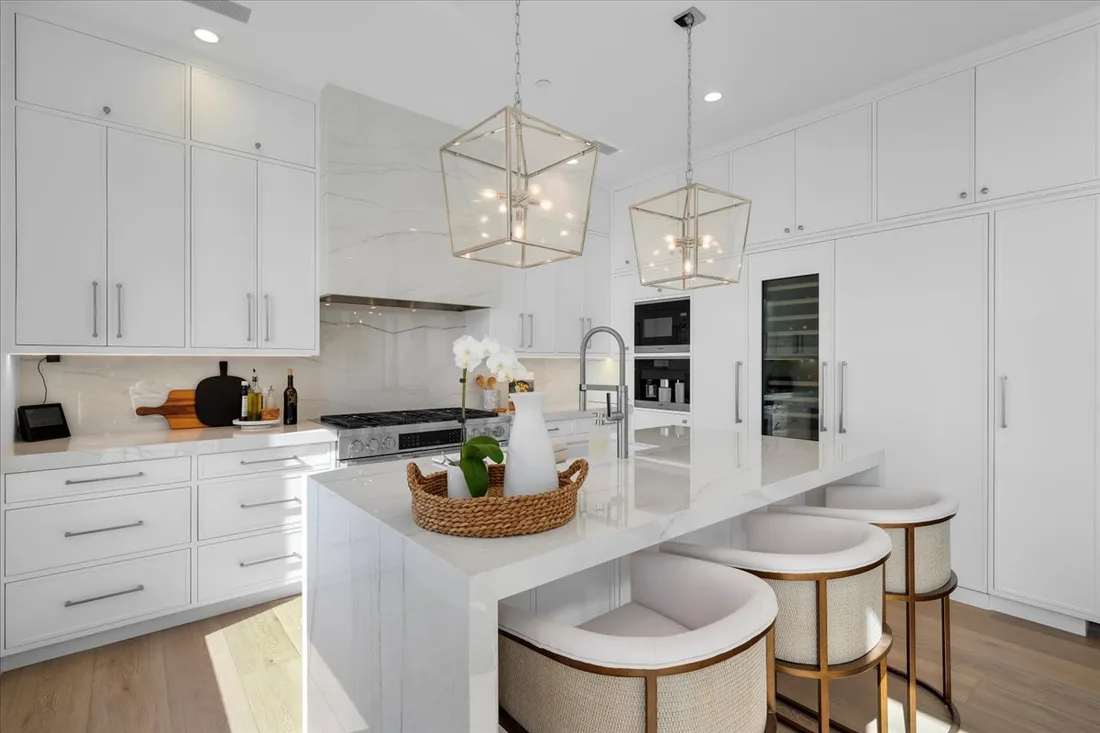
Walnut on the island, restraint everywhere else. That's the version that still looks considered in ten years.
Ways we specify walnut
Walnut island, painted perimeter
The highest-impact, best-value version. The walnut lands where people gather and touch, and the perimeter carries the room without tripling the material cost.
Learn more →Full walnut, frameless
Slab doors in a frameless build let the grain run uninterrupted across a wall. It's the most demanding version to lay out and the most striking when it's right.
Learn more →Walnut with white oak
Two natural woods in one kitchen, kept apart by tone and placement, is a harder trick than wood-and-paint — and worth it when it lands.
Learn more →Walnut interiors & details
Drawer boxes, open shelving, a hood surround, or an appliance garage in walnut — a small quantity of it in the right place does a lot of work.
Learn more →Matched to the countertop
Walnut wants a counter that doesn't fight it. We design the slab and the cabinetry together rather than choosing one and hoping.
Learn more →Panel-ready appliances
Walnut panels on refrigeration and dishwashers keep the grain running clean instead of breaking it with stainless.
Learn more →
What a walnut kitchen costs, and what protects it
Walnut sits at the upper end of custom cabinetry pricing — above white oak and well above painted maple — because of grade and yield rather than any difference in how it's built. Where a specific kitchen lands depends on how much walnut is actually in it, whether it's steamed or unsteamed, the finish, and the interior fittings, which is exactly why we price it in writing after seeing the space. For how the tiers compare in general, our cabinet cost breakdown lays out the full range.
On finish: walnut should be sprayed, not brushed, in a catalysed topcoat with UV inhibitors. A hand-applied oil finish looks glorious on day one and is a maintenance commitment most people regret in a working kitchen — it wants re-oiling and it stains where a wet glass sits. If you want the low-sheen oiled look, we can get very close with a matte catalysed finish that doesn't ask anything of you.
Compare cabinet tiers and cost →Walnut cabinet FAQ
Do walnut cabinets get darker over time?
No — walnut is one of the few woods that lightens. The deep purple-brown of a fresh board mellows toward a warmer honey-brown over the first few years, and the contrast within the wood softens. A catalysed finish with UV inhibitors slows it considerably, but nothing stops it, so it's worth choosing against aged samples rather than fresh ones.
Is walnut durable enough for a kitchen?
Yes, with a clear caveat: walnut is noticeably softer than white oak, so it dents more easily. On a hard-working family island, some people read that as character and others as damage. If a pristine surface matters to you, oak or a painted finish is the more forgiving choice.
What's the difference between steamed and unsteamed walnut?
Steaming during drying pushes colour from the heartwood into the pale sapwood so boards blend more evenly. It solves colour mismatch but flattens the reds and purples into a more uniform brown. Unsteamed walnut keeps far more depth and character, costs more, and needs careful layout. Ask which you're being quoted — the difference is real and rarely itemised.
How much do walnut kitchen cabinets cost?
Walnut sits at the upper end of custom cabinetry, above white oak and well above painted maple, driven by grade and yield rather than construction. Where your kitchen lands depends on how much walnut is in it, steamed versus unsteamed, finish, and interior fittings — so we quote in writing after seeing the space.
Can I get the walnut look without a full walnut kitchen?
That's how we spec it most often. A walnut island with a painted or white-oak perimeter puts the material exactly where it's seen and touched, and keeps the cost sane. It also tends to age better as a design than a room finished entirely in one dramatic wood.
Does walnut work in a coastal South Bay kitchen?
It does, though it reads warmer and more formal than the rift white oak most coastal kitchens use. Near the water we're careful about the finish schedule regardless of species — humidity and salt air are hard on cabinetry, which is why plywood boxes and catalysed topcoats are standard for us rather than an upgrade.
See walnut in your own light
We'll bring samples — steamed and unsteamed, fresh and aged — into your kitchen so you're choosing against the real thing. Tell us about your project and we'll get back to you, usually the same day.